

How many times have you felt overwhelmed, not by work that stopped mattering, but by the week pulling you from one urgent request from senior leadership, or one fire, to the next? The initiative you lost track of. The action item that slipped. The 1:1 you walked into without remembering what you promised last time, or what was weighing on that person three weeks ago.
I have, more than I would like to admit.
Attention — The Engineering Director’s Job
I lead a group of teams in the OutSystems engineering organization. Multiple teams, dozens of engineers across mobile, frontend, and backend, with more work running in parallel than I can hold in my head on any given day. In my role, I am accountable for what’s generally expected of an engineering director. This means being the glue between strategy and execution. I have to manage managers, oversee delivery across teams, and grow the managers under me. At the same time, I’m expected to raise the technical bar and be the voice of engineering. Influence is the job, not the code. All of that is true.
But when I am honest about the day-to-day, it all comes down to attention.
Where mine belongs, what I miss, and what slips through the cracks while I’m reacting to whatever is in front of me.
When ChatGPT was released in late 2022, the obvious move was to point it at the work. Read my emails, summarize the documents, draft the messages, and hand me back the output. Useful, but I knew that could not be the center of it. I did not want a system that did my thinking for me and gave me summaries to rubber-stamp (the moment I stop reading the hard things myself is the moment my judgment starts to rot). I wanted the opposite. Something that made me sharper at the parts of the job that are mine, and carried the parts that keep falling on the floor.
That is the principle behind a system I have been building and running for the last few months, and it has quietly changed how I work.
So I started where I always try to start, from first principles. Not with a tool, or an app, or someone else’s template. Instead, I asked myself: what is the actual job of an engineering leader? When you strip away the title, the calendar, and the noise, what am I really responsible for?
My answer, for my role, came down to a few things. Making sure the organization is working on the right problems. Holding the bar on how we build, and the principles we build by. Growing a strong team and strong leaders inside it. And underneath all of that, the quieter work nobody puts on a job description, such as paying attention, remembering, deciding, and following through.
Leadership is fundamentally an attention management problem.
Once I had that written down, the shape of the system fell out of it.
The operating system
Before I go any deeper, here is what the system consists of. At its simplest, it is organized into folders, one each for the people I lead, the teams, the initiatives, the decisions, and the reviews, that an AI agent reads and writes alongside me. On top of those sit the skills and connectors (MCPs and CLIs) that let it run the routines I do often: the morning briefing, the weekly and monthly reviews, gathering meeting notes, logging decisions, and reaching into the tools I already use to pull in extra context.
Press enter or click to view image in full size
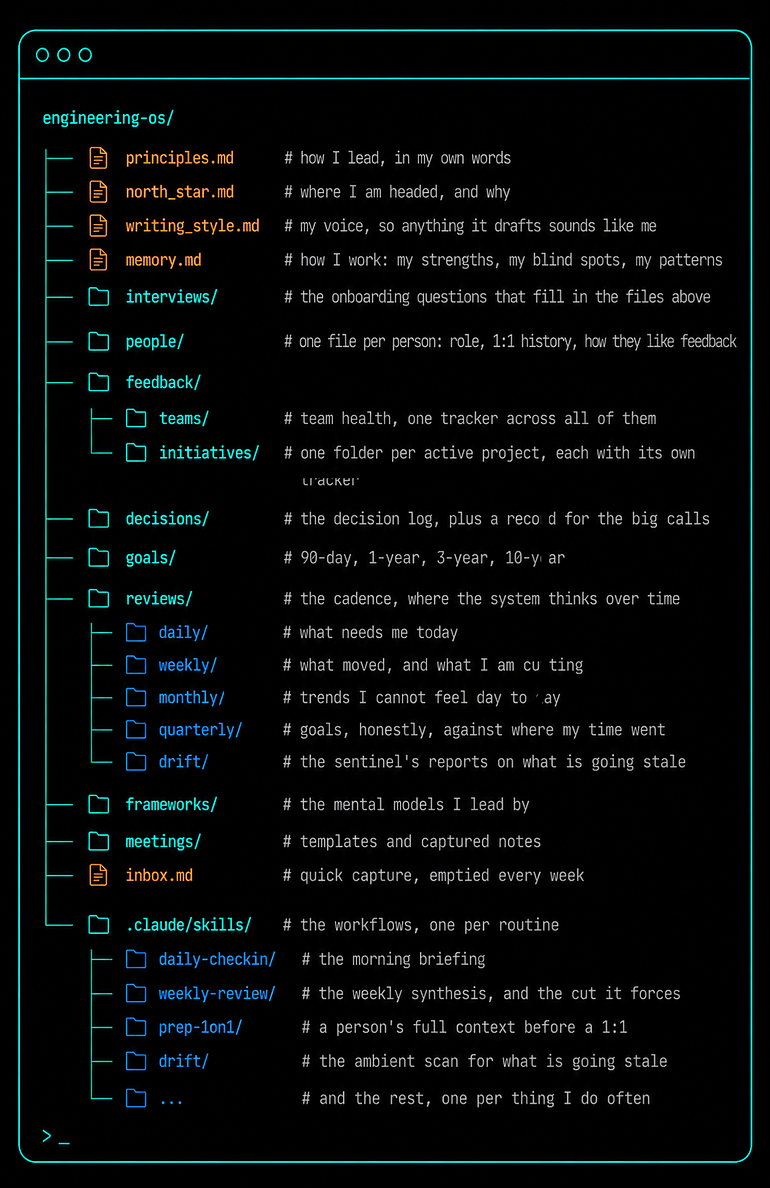
That is the whole thing. The structure is the easy part to copy, and I will get into how it is built and how it runs further down for anyone who wants the mechanics. But on its own, it is not enough. What makes it work is the handful of principles I kept coming back to while building it, the things that decide whether a system like this sharpens you or just becomes one more thing competing for the attention you are already short on. The first became obvious almost immediately: it could not be generic.
Personal, or it’s slop
The reason most AI output feels like filler is simple: it doesn’t know you. It doesn’t know what you value, how you think, the words you would never use, the bar you hold, or the things you are trying to get better at. Point a generic model at a generic prompt and you get generic text back. Slop.
So before the system could be useful, it had to learn who I am. The first thing you do with it is not a task. It is an interview. It asks about your values, the mental models you actually trust, how you write, where you are strong, and where you still need to grow. That conversation becomes the foundation on which everything else is built.
The difference shows up everywhere after that. When it helps me draft a message, it sounds like me, because it has read how I write and knows the phrases I avoid. When it reflects something, it reasons in the frameworks I use. When it pushes me, it pushes on the specific things I told it I am working on, not on some textbook idea of a better leader.
I think this is the part most people skip, and it is the part that matters most. Personal is the whole point. A system built around you amplifies you. A system built around no one in particular just adds to the noise.
It works like a chief of staff
A chief of staff is one of those roles most engineering leaders will never get a budget for. The good ones hold your context, keep your commitments visible, prepare you for the room you are about to walk into, and remember the things you are too busy to hold. I came to see that as most of what would make me a better leader, so that is what I built.
Every morning, it gives me a briefing. It reads across my calendar, my teams, the people I lead and meet with, my goals, my plan for the week, and the loose ends I left yesterday. It tells me what actually needs me today. The action item I let slip last week. The goal with a deadline that is closer than I thought. The person I have not had a real conversation with in three weeks. It is a quiet “here is what you are about to drop, before you drop it.”
Before a 1:1, it pulls together what matters. What we talked about last time, what I committed to and have not closed, what was weighing on them, the win worth acknowledging, even how they like to hear hard news. I walk in prepared, instead of rebuilding the context in the thirty seconds before the call. And it keeps getting more reliable. Now that I connect it to my meeting transcripts (in my case Zoom, or a tool like Granola, whatever you use), it adds the meeting’s real record on top of my own notes. This can include what was discussed, what was decided, the action items, and who owns them. Captured, not left to what I remembered to write down.
And it remembers. Not just this week, but months back: what I decided and why, the pattern across a person’s last several check-ins, the thing I said I would revisit and never did. Human memory does not work at this scale. This does.
None of this is glamorous. It is the unglamorous middle of the job, the part that decides whether you are a leader people can rely on or one who keeps letting things fall.
It amplifies me, but it does not replace my judgment
Here is where it would be easy to go wrong. With everything I just described, the obvious next step is to let it read everything and hand me the answer. It could. It can reach my email, my documents, the threads I am tagged in. Plenty of people are racing to set their systems up exactly that way, and they talk about it like a badge.
I do the opposite, on purpose. I still read the solution design myself. I sit with the problem statement myself. I read the hard email myself, slowly, before anyone summarizes it for me. Those are the moments where judgment is formed, and judgment is the job.
The day I start approving conclusions I did not reach myself is the day I stop being the person who should be making the call.
So the system does not get to think for me on the things that matter. What it does is capture my conclusion and connect it to everything else I know. I read the document, I form my view, and it files that view where I will find it again, next to the three related decisions I made two months ago that I would never have remembered on my own.
It is a second brain, not a replacement for the first one.
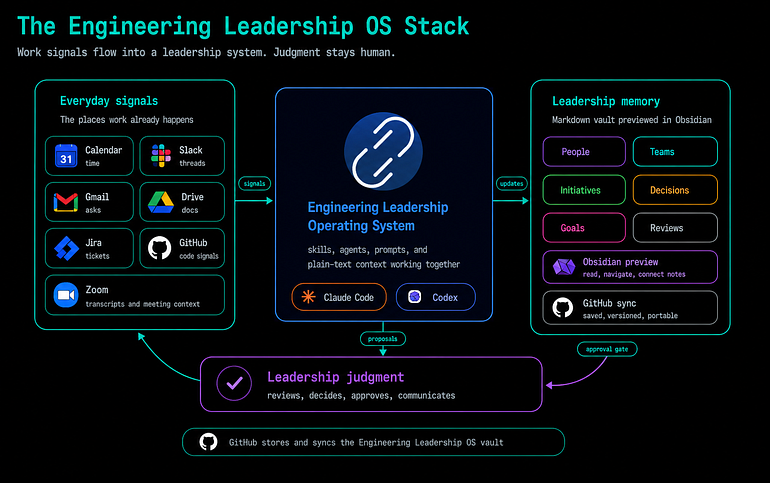
There is a mechanism at work here, along with a principle. The system can gather context, draft a message, propose a tracker update, or route an action item to the right place. But it does not send, publish, or file anything that matters without me reviewing it first. That gate matters more in leadership than in most work, because the context it touches is often confidential, half-formed, or political. It does the legwork, but the decision, and anything that leaves my hands, stays mine.
This is the part I would push hardest on with other leaders. It is tempting to let the summaries do the reading, especially when you are busy. But the busy is exactly when you can least afford to let your own thinking go soft.
Amplify the judgment, do not outsource it.
It is built around weaknesses, not just strengths
This is the principle I care about most, and the one most tools ignore.
Most productivity tools are built around your strengths. They help you do more of what you already do well. I wanted the opposite. When I set the system up, I told it not just what I am good at, but where I tend to fall short, the patterns most leaders carry and would rather not look at too closely.
Then I built it to push on exactly those patterns. This is where forcing functions come in. If your instinct is to hold on to too much, it makes you name what you are cutting every week. If action items tend to age quietly in a corner, it puts them back in front of you before they rot. If a goal keeps slipping, it says so plainly, instead of letting you scroll past it the way you would on your own.
A system that only organizes your work is comfortable. A system that reflects the gap between what you said you would do and what you actually did is not. That discomfort is the entire value. It is the closest thing I have to a coach who pays attention every single day, and who has no reason to flatter me. It does make me more productive. But what I value most is that it closes the gap between the leader I am and the one I am trying to become, a little, every week.
The point is to carry less.
I should be honest about where the first version fell short. It was very good at capturing and generating, and weaker at retrieval and closing the loop. That is the trap every notes system falls into: more notes, more reviews, more context, until it produces more for me to read than it takes off my plate. Write-heavy, read-light.
That failure forced the rule the whole system now runs on. Every automation has to remove work from me, not create another artifact I have to read.
The daily plan allows no more than three things that must land. The weekly review will not finish until I name at least two things I am cutting. Tab triage defaults to dropping, not saving. The drift scan caps what it surfaces, because a long list of problems is just another thing to ignore. Most AI workflows add another summary, another draft, another dashboard. This one is built to subtract. That is the part I would not give up.
How it’s built
I showed the skeleton earlier. Here is what actually runs it, which is less exotic than it sounds. It begins with the interview from before, the one that taught it my values, my voice, and where I am trying to grow. Everything else is built on top of that.
On top of the files sit the workflows, one small skill per routine I run often: the morning briefing, the weekly and monthly reviews, meeting capture, decision logging, a background scan for what is going stale. I trigger them in plain language.
And here is exactly what runs it. The engine I use is Claude Code, the assistant that reads the files, runs the skills, drafts in my voice, and writes back into the vault. I read and navigate everything in Obsidian, which previews the Markdown, follows the links between a person, their team, and the decisions they touch, and renders the diagrams. And at the end of the day it is a git repo, committed and pushed to GitHub, so I have the full history, a backup of my machine, and the same vault on every device. Nothing is ever lost, and I can see how my own thinking changed over time.
There is no product here, no subscription, no dashboard I log into. A handful of general tools, none of them built specifically for this, all working on plain files I own. If any one of them disappeared tomorrow, the system would still be sitting there on disk. That is the point.
And to keep all of that grounded in what is actually happening, it connects to the tools I already work in: my calendar, Gmail, Slack, Google Drive, Jira and Confluence, GitHub, Zoom and others. That is how the morning briefing knows about today’s meetings, the ticket that moved, or the thread I got pulled into, without me copying anything over by hand.
Drawn out, the whole stack is just this:
Press enter or click to view image in full size
How it works
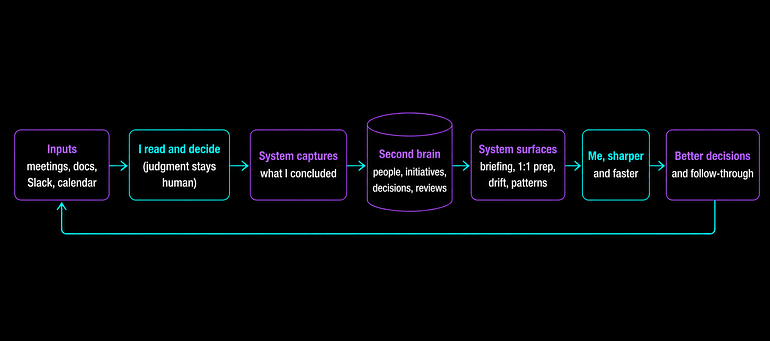
Everything runs as a loop. Information comes at me all day from meetings, documents, Slack threads, the calendar, plus the work I start myself. I read and decide on the things that need my judgment, and that step stays mine. The system takes it from there. It captures what I concluded, files it into a second brain organized around the people, initiatives, and decisions I am responsible for, and then surfaces the right piece back to me at the right moment.
A briefing in the morning. The context I need before a one-on-one. A quiet flag when something is drifting. That makes the next decision faster and better, which creates the next thing to capture. Round it goes.
Press enter or click to view image in full size
Take meetings. Alongside the notes I take myself, the system pulls in the Zoom transcript, and from both it picks out the action items and the decisions. The decisions go to the decision log, with the reasoning, so a choice made in one call is not lost by the next. The action items get routed: the ones I own land in my inbox or the week plan, so the work gets scheduled instead of evaporating the moment the call ends.
This is where it stops being a memory and becomes leverage. Once everything sits in one connected place, the people, the decisions, the goals, the history, the system can work on top of it instead of just handing it back. It can weigh what actually matters against what is merely loud, and point my attention at the few things that need it. It can take a real problem I am working through and give me a first pass that already knows my teams, my constraints, and the calls I made before, not generic advice I have to translate into my world. And it builds on itself: every meeting captured and every decision logged makes the next answer sharper. That is the line between a system that remembers for me and one that helps me think, and it is what clears the way for the work only I can do.
The second loop is slower, and it is the one that compounds. A short daily check-in rolls up into a weekly review, the weekly into a monthly, the monthly into a quarterly. Each level zooms out: the day catches what is in front of me, the week and the month surface what I cannot feel in the moment, and the quarter is where I check my goals honestly against where my time went.
Press enter or click to view image in full size
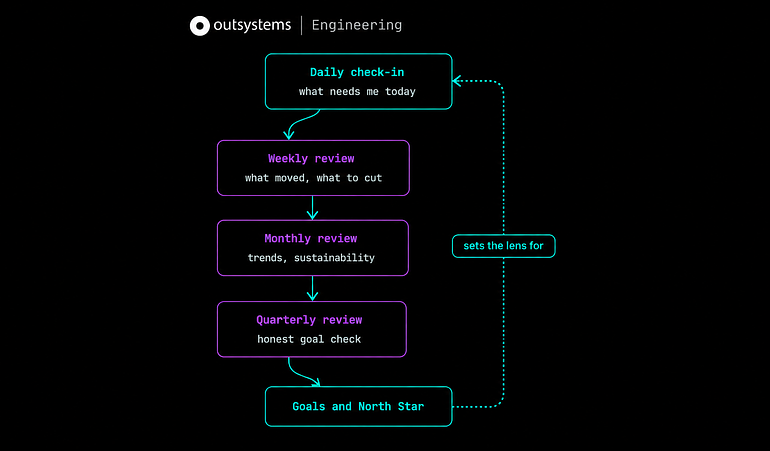
The cadence rolls up to a top layer of goals, and I keep that layer deliberately open, so it bends to whatever you and your organization actually use, V2MOM, OKRs, a north star, instead of forcing someone else’s.
Running the reviews on a cadence is what lets me look back, see the progress I am making, and reflect on what comes next. The weekly review makes me face what moved, what stalled, and what I am cutting, and adjust before a small drift becomes a real problem. The month and the quarter do the same over a longer lens. It is how I catch my own patterns and correct course on a schedule, instead of waiting for something to break to force the issue.
My conviction
Our roles are changing with AI. So I rethought my own job from first principles and built an operating system for leading through that change. Somewhere in that, my relationship with the work changed too.
The job did not get smaller. Multiple teams, dozens of engineers, more in flight than I can hold. What changed is that I am on top of it instead of under it. Less reacting to whatever is loudest, more deciding what actually matters and getting there first. The reacting, the remembering, the prep, the follow-through, the slow erosion of small things slipping while I look elsewhere, that is the load I handed to the system. The judgment, the hard calls, the conversations, the direction, I kept all of that. If anything I have more room for it now.
And that room matters more than it used to. AI is making teams faster and raising what they can produce, which sounds like it should make the leader’s job lighter. It does the opposite.
When output gets cheaper, direction gets scarcer.
The hard part is no longer doing the work, it is deciding what is worth doing, holding the bar, and seeing where all of this is going. The era is asking leaders for more strategic and visionary work, not less. But you only get to do that work if you are not buried under the operational grind, and for most of us, it never lets up on its own.
That is my conviction. AI will not replace engineering leaders. It will raise the bar. The ones it elevates are those who use it as an amplifier, built around who they are and with their judgment kept sharp. The operational work stays handled, and they can finally spend themselves on the part only they can do. Not doing less. Doing what matters, and getting to it first.
And raising the bar is concrete. We are the ones who have to lead the shift to agentic engineering, and lead it well, which means holding harder than ever to the fundamentals: quality, reliability, speed that comes with real guardrails, not without them. We are also the ones who have to make the investment in AI actually pay off, in our teams and in what we ship. The technology is extraordinary. Whether an organization truly gains from it comes down to whether its leaders hold the bar while the speed goes up.
I did not invent any of this. The idea of a personal operating system came from people building versions of it in other roles. I took that inspiration and built one for engineering leadership, but it’s a version I believe can work for people in many different roles across a product organization.
What’s next
This started as a fix for my own problem, and it has kept evolving as I use it. That will continue. A few things I am working toward:
- Move the goals layer fully onto V2MOM, so the whole cadence rolls up to it.
- Build a plugin system so the skills and flows can be assembled for different roles. I built this for an engineering director, but the same pattern should help far more people than that.
- Keep improving the version a few teammates already use, and make it something they can update, so it gets better over time instead of going stale.
And I will be honest, writing this was one of the things the system kept telling me to do, week after week, until I finally did. So it works. Slowly, on me too.
This article introduces the overall operating system. Over the coming weeks, we’ll dive deeper into the individual pieces. Stay tuned!